
Empowering Communities Together
Air Sourced Heat Pump
What was done.
We live in a refurbished 1950s House with a dormer-style roof and were worried the environmental impact of burning fossil fuels, which contribute to rising CO2 levels and climate change.
In 2022, we participated in the national electrification of heat demonstration project, which tested the suitability of various UK home types for heat pump technology and had an Air-to-Water sourced heat pump installed, replacing their unreliable gas combi boiler. The system included new radiators and a hot water tank and was monitored remotely for 18 months. The house has an EPC rating of C, with 250mm of loft insulation, double-glazed windows, and wall insulation. Before the heat pump installation, the house used approximately 15,000 kWh of gas annually.
The Air-to-Water Heat Pump uses refrigeration to extract heat from the outside air, achieving greater than 100% energy efficiency. During the trial, it achieved an efficiency of around 250%.
The system includes an outdoor Monobloc with a compressor and heat exchangers, an internal pump, a hot water tank, and radiators. It is controlled via an interface controller in the garage plant room. An energy survey and heat loss calculation were completed before installation. The installation and commissioning took four days, and the system was heavily monitored and modified for optimal performance.
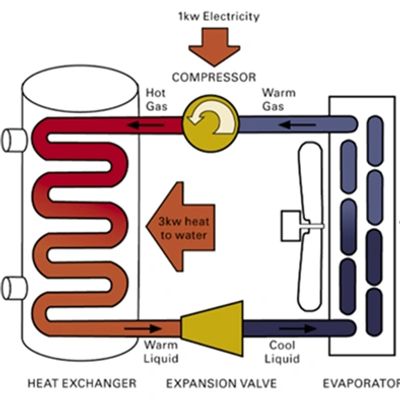
How it works - Heat Pump Cycle
Air Sourced Heat Pump
How it performs and Final Thoughts
Initially, the system operated with a fixed flow temperature of 45°C, which was later adjusted to a "Weather Dependent" mode for improved efficiency. This mode alters the temperature the radiators are heated to, depending upon the outside air temperature, to keep the house at a constant temperature. The system consumed 4078 kWh of electricity to produce 10,329 kWh of heat in 2024, costing approximately £1049 at standard tariff rates.
However, with additional investments in solar PV, batteries, and time-of-use tariffs, the effective electricity cost was reduced, resulting in a £600 annual saving and CO2 savings of 2200 kg per year
We are pleased with the heat pump's performance, which effectively warms the house even during the coldest months. Proper initial loss calculation and commissioning are recommended for achieving the highest energy efficiencies.
If you would like to find out more about this installation, please don't hesitate to contact BFCCA, who will be pleased to put you in touch with Russell to answer any questions you may have or sign up for Nesta’s visit a heat pump scheme to talk to a Heat Pump owner near you.

Hot water Tanks and Outside Compressor, Heat Exchanger and Evaporator